
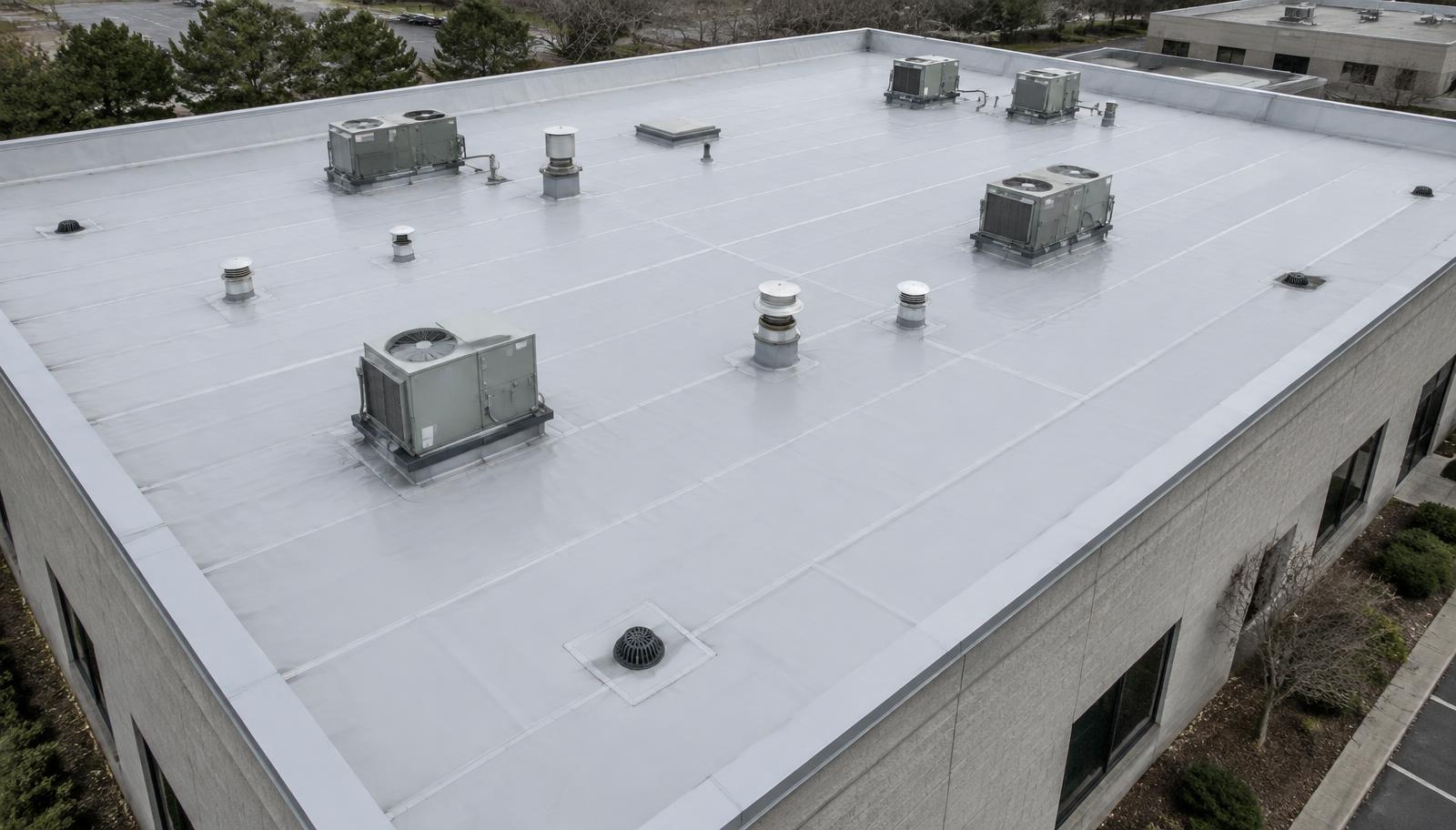
Roof Systems
PVC Roofing
PVC is a heat-welded single-ply membrane for low-slope roofs, often weighed where rooftop exposure matters. We review your building, existing roof, and operations before recommending it for an installation, recover, or replacement.
What PVC Is
Is PVC right for your building?
PVC (polyvinyl chloride) is a flexible, reinforced thermoplastic membrane for low-slope and flat roofs. Sheets overlap and are welded with hot air into continuous seams. It suits many commercial and industrial buildings, particularly those with demanding rooftop exposure, but the decision depends on your facility.
Rooftop exposure
Grease, oils, and exhaust from kitchens or process equipment influence which membrane will hold up.
Existing roof and substrate
Some existing materials are incompatible with PVC and need a separation layer where the manufacturer requires one.
Insulation and drainage
Insulation thickness, slope, and drain locations shape the assembly beneath the membrane.
Recover or tear-off
Moisture, the number of existing roofs, and deck condition determine whether a recover is an option.
Why Owners Choose It
Benefits of PVC
Long-term service
PVC is an established roofing option. Service life depends on the selected assembly, installation quality, roof conditions, and ongoing care.
Cost of ownership
Consider maintenance and repair needs alongside installation costs. A repairable roof can offer value when the surrounding assembly remains sound.
Chemical resistance
Where exhaust or grease reaches the roof, material compatibility matters. We review the expected exposure against the membrane manufacturer’s guidance.
Fire performance
PVC can be specified within a fire-rated assembly. Confirm the rating for the complete roof system rather than the membrane alone.
Weather protection
Heat-welded laps form the connections between sheets. Attachment, flashings, and drainage must also suit the building and local conditions.
Bioresistance
PVC membranes offer resistance to biological growth. Keeping the surface and drains clear remains part of routine roof care.
The Assembly
How a PVC roof comes together
A PVC roof works as a complete assembly: deck, insulation, any cover board or separation layer, and the welded membrane, tied together at edges, penetrations, and drains. The attachment method depends on the deck, wind requirements, and what the manufacturer approves for that system.
Fully adhered
The membrane is bonded to an approved substrate with adhesive, leaving a smooth surface without fastener rows.
Mechanically attached
Fasteners and plates hold the sheets along the laps, and the next sheet is welded over them. Widely used on steel decks.
Induction-welded
Plates fastened through the insulation are bonded to the membrane’s underside with an induction tool, without penetrating the sheet.
Each method is used only where the selected manufacturer approves it, and every component must be compatible with PVC.
Your Options
Options for your PVC roof
Planning a new PVC roof or dealing with leaks on an existing one? We find the cause first, then recommend the scope that addresses it, whether that is a repair, a recover, or a new system.
New installation
A PVC assembly planned around the building's exposure, insulation, drainage, and rooftop equipment.
Learn about New installationReplacement or recover
We check moisture, existing layers, and substrate compatibility to decide between a tear-off and a recover.
Learn about ReplacementRepair and maintenance
Open laps, punctures, and flashing issues can often be repaired with welded PVC patches.
Learn about Repair & maintenance
Before We Recommend
What we evaluate before recommending PVC
Roof condition and moisture
Where the existing membrane has failed and whether water has reached the insulation.
Drainage
Slope, drains, scuppers, and any areas where water collects.
Deck and attachment
The deck type and condition, and which attachment methods it can support.
Rooftop exposure
Grease, oils, exhaust, and process discharge, checked against the manufacturer’s compatibility guidance.
Substrate and insulation
Existing materials that may need separation from PVC, plus insulation thickness and condition.
Access and operations
How work can be staged around your tenants, staff, and day-to-day operations.
Questions
PVC roofing FAQs
There is no universal winner. Both are heat-welded thermoplastic single-ply membranes. PVC is often considered where oils, grease, or exhaust reach the roof; TPO is a common choice where those exposures are limited. Your building's use, existing roof, and budget decide which fits.
It can be. Kitchens, food processing, and some manufacturing operations discharge substances that affect roof membranes. We identify what actually reaches your roof and confirm the membrane manufacturer lists it as compatible before recommending PVC.
Often, yes. Punctures, open laps, and damaged flashings can usually be repaired with welded PVC patches when the membrane is still clean and weldable. Widespread wet insulation or brittle, aged membrane can make replacement the better choice.
Sometimes. A recover depends on moisture in the existing roof, how many roofs are already in place, deck condition, and code. PVC can be incompatible with some existing materials, such as asphalt-based roofs, so a separation layer may be required by the manufacturer.
Price depends on roof size and access, tear-off or recover, insulation, attachment method, membrane thickness, and the number of penetrations. Plan on periodic inspections and clear drains. Warranty terms depend on the manufacturer and specified assembly, and we review them with you during planning.
Let’s evaluate your roof.
Tell us what you’re seeing and what you’re planning. We’ll help you understand your roof’s condition and the options worth considering.